
Monsoon Skin Problems: Why Your Skin Breaks Down Every Rainy Season, and the Ayurvedic Way to Fix It
By Dr. Dipti Deshpande, BAMS | Panchkarma Specialist & Ayurvedic Physician | Swaanubhutii, Pune
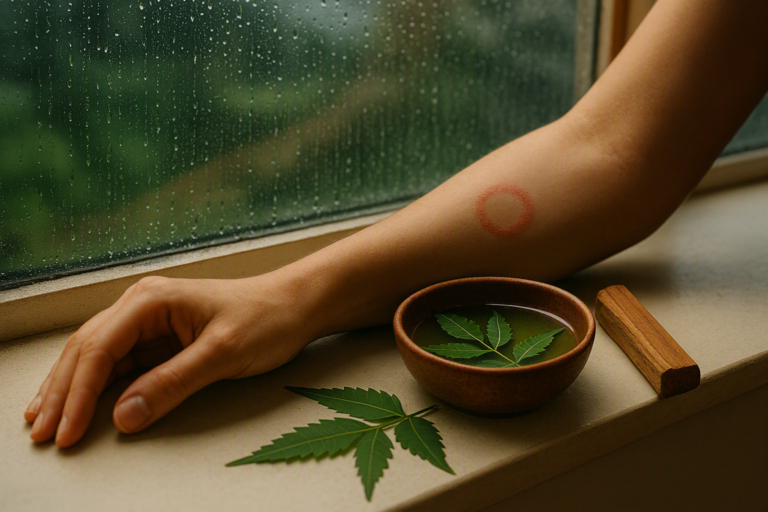
Of all the seasonal health complaints I see at Swaanubhutii, monsoon skin problems are among the most distressing for patients — not because they are the most serious, but because the skin is visible. A flaring rash on the neck, a sudden cluster of breakouts on the jaw, a fungal patch spreading silently on the inner thigh or between the toes — these are the things patients apologise for as they walk in, as if the skin’s monsoon behaviour is somehow their personal failing. It isn’t. It is, in most cases, a completely predictable, seasonally-driven pattern, and Ayurveda has been describing and addressing it for centuries.
Understanding why monsoon skin problems happen — not just what to apply on them — is what makes the difference between managing symptoms that return every year and actually reducing their severity over time.
Why Monsoon Is the Season Your Skin Struggles Most
Varsha Ritu, the Ayurvedic monsoon season, creates a specific combination of conditions that the skin is particularly ill-equipped to handle in isolation. Humidity rises sharply, preventing normal sweat evaporation and creating a warm, moist microenvironment on the skin surface — ideal conditions for bacterial and fungal proliferation. At the same time, Pitta Dosha, which governs all inflammatory processes and skin tissue (Twak Dhatu), is in a state of accumulated excess from summer’s heat, already primed to flare with the smallest provocation. And Kapha, rising with the dampness and heaviness of monsoon, adds congestion and sluggishness to an already compromised skin environment.
These three factors — excess moisture externally, accumulated Pitta internally, and rising Kapha creating congestion — act simultaneously on the skin, which is precisely why monsoon skin complaints have a particular character: they tend to be inflamed, damp, spreading, and stubborn. A normal dry-weather breakout clears in days; a monsoon breakout, left unaddressed at the root, can persist for weeks or evolve into something more widespread.

The Three Most Common Monsoon Skin Problems, Explained
Fungal infections (ringworm, athlete’s foot, skin fold rashes). These are the most classically monsoon-specific skin complaints. In Ayurvedic terms, they represent excess Kapha and Pitta acting on the skin’s channels (Twacha Srotas), creating the warm, damp, stagnant conditions that allow fungal growth to take hold. They appear most commonly in skin folds — the groin, inner thighs, underarms, between the toes — anywhere the monsoon’s ambient moisture becomes trapped against the body. The skin turns red, may develop a defined ring-like border, and typically intensifies after sweating or getting wet in the rain.
Monsoon breakouts and acne. These are driven by excess Pitta — the internal heat accumulated through Greeshma Ritu (summer) finding its outlet through the skin as Pitta-rich sweat mixes with monsoon humidity and clogs follicles. The character is distinctive: red, tender, inflamed lesions rather than the simply congested, non-inflammatory comedones typical of other seasons. Patients with already Pitta-dominant skin find this season particularly difficult, as their usual management simply isn’t calibrated for the additional humidity layer.
Prickly heat and heat rashes. A residue of summer’s Pitta that doesn’t fully resolve with the onset of the rains, prickly heat persists and sometimes worsens in early monsoon because humidity prevents the evaporative cooling that would normally help clear it. In Ayurveda, this is understood as Pitta-in-Twak — excess heat lodged in the skin tissue itself, manifesting as the characteristic burning, pricking, and redness that patients describe as “the monsoon making summer worse rather than better.”
What Most People Get Wrong When Treating Monsoon Skin
The most common mistake I see is patients treating monsoon skin problems purely externally and reactively — applying antifungal creams the moment a ring appears, switching to oil-free moisturisers the moment breakouts begin, using cooling powders on prickly heat. These measures provide short-term relief but don’t address why the skin became vulnerable to these problems in the first place.
The second common mistake is over-washing or over-cleansing, driven by the feeling that monsoon skin feels constantly unclean. Stripping the skin barrier repeatedly with harsh cleansers in an attempt to manage oiliness or sweat leaves the skin more permeable and more vulnerable to the very infections it’s trying to prevent. The skin’s acid mantle — its natural protective barrier — needs to remain intact; what it needs in monsoon is not aggressive cleansing but intelligent management.
The third, and perhaps most impactful, mistake is ignoring the internal Pitta load that is driving the skin’s reactivity. Continuing a summer diet of spicy food, fermented foods, excess tea and coffee, and late nights into the monsoon season keeps Pitta elevated at exactly the moment it needs to be actively calmed.
The Ayurvedic Approach — From Inside and Outside, Simultaneously
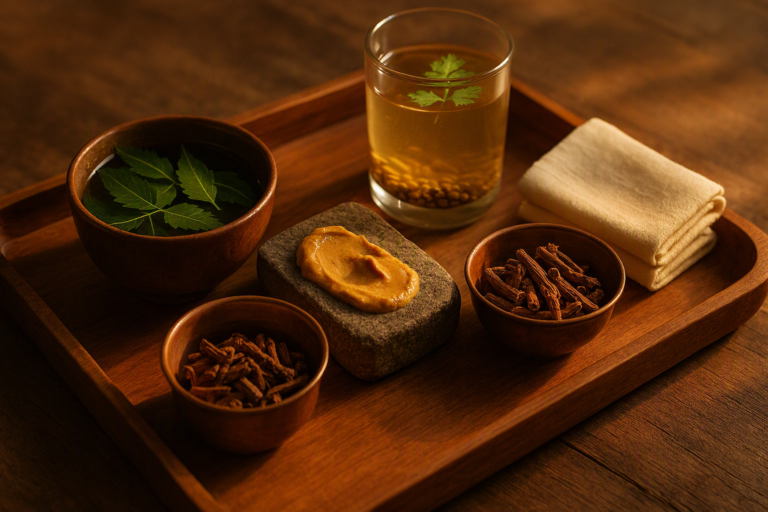
Internal Pitta cooling first. Switch to a Pitta-pacifying diet through the season: reduce spicy, sour, and fermented foods; favour bitter vegetables like karela and methi; include cooling herbs like coriander, fennel, and mint generously in cooking. A glass of coriander seed water (one teaspoon soaked overnight, strained in the morning) on an empty stomach is a classical internal Pitta reducer that directly benefits skin clarity over 2 to 3 weeks of consistent use.
Neem — Ayurveda’s primary skin herb in monsoon. Neem is specifically classified as Kushtaghna in Ayurveda — skin-disease-destroying. Both internal use (Neem capsules or decoction, under guidance) and external use (Neem water for washing affected areas, Neem-based face packs) address the Pitta-Kapha skin pattern directly. For active fungal infections, bathing with Neem-infused water is among the most effective traditional approaches available.
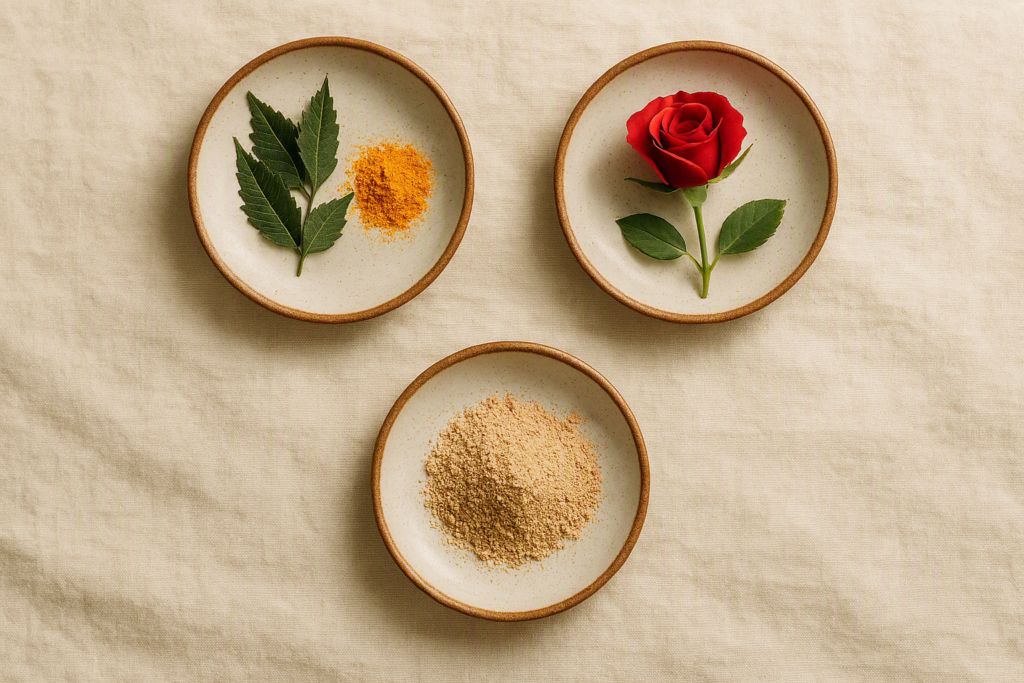
Sandalwood (Chandan) for inflamed and breakout-prone skin. Chandan paste applied to breakout-prone areas for 15 minutes draws Pitta heat out of the skin rather than simply covering it, reduces redness, and has natural antimicrobial properties that complement its cooling action. Used 2 to 3 times a week through monsoon, it significantly reduces the frequency and severity of Pitta-driven breakouts without disrupting the skin barrier.
Keep skin dry and airy — Kapha management externally. Change out of wet or sweat-dampened clothing immediately; allow skin folds to air properly after bathing; avoid synthetic fabrics that trap moisture against the skin. These sound like common sense but are clinically the most important non-medicinal steps in preventing monsoon fungal infections from establishing or recurring.
Manjishtha for deeper Pitta-in-blood clearance. For patients whose monsoon breakouts have a pattern of recurring in the same locations year after year, or are accompanied by warmth and spreading redness, this usually indicates Pitta has entered the Rakta (blood tissue). Manjishtha is the classical Raktashodhaka — blood-purifying herb — in Ayurveda, and addressing this deeper layer is what prevents the cycle from repeating each monsoon.
When to Seek Clinical Treatment Rather Than Self-Managing
Monsoon skin complaints that spread rapidly, appear in multiple sites simultaneously, or fail to respond to basic home care within 7 to 10 days have almost always moved beyond what topical care alone can resolve. At this point, the deeper Dosha imbalance driving the skin’s behaviour needs to be addressed clinically — typically through a short Virechana-based Pitta detox protocol, targeted Rakta-shodhana (blood-purifying) formulations, and in some cases, Takradhara (buttermilk Shirodhara modified for Pitta skin conditions), which has a remarkable and underappreciated record in chronic, recurring Pitta skin diseases.
The right time to come in is not after six weeks of topical antifungal that’s achieved partial clearance. It’s after the first 7 to 10 days of home care if the picture isn’t clearly improving.

How We Approach Monsoon Skin at Swaanubhutii
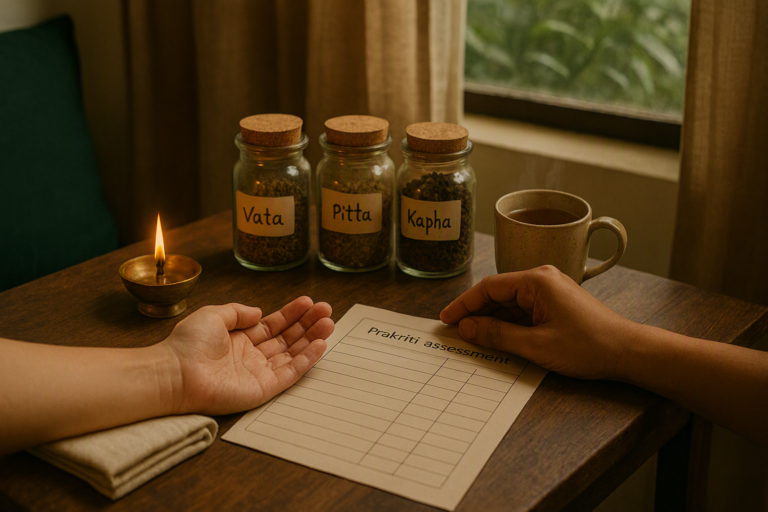
Our approach to monsoon skin always begins with a detailed Prakriti and Dosha assessment — understanding whether the dominant pattern is Pitta-driven inflammation, Kapha-driven congestion and fungal susceptibility, or (most commonly) a combination of both. From this, we design a personalised plan that addresses the internal Dosha root and the external skin care simultaneously, rather than treating the skin as a separate organ.
For patients who come to us every monsoon with the same skin complaint, we also look back at what didn’t fully clear the previous year — because recurring, same-site monsoon skin problems almost always indicate an underlying imbalance that persists between seasons and simply declares itself loudly when the season provides the right conditions. Addressing this between-season baseline is where Ayurveda’s strongest preventive potential lies.
How Many of These Apply to You?
If three or more of these five signs are part of your daily experience, your body is clearly asking for a Panchkarma detox. This is not a luxury spa treatment. Panchkarma is classical Ayurvedic medicine, practiced for thousands of years, and today supported by growing clinical evidence for its effects on inflammation, gut health, neurological balance, and systemic wellbeing.
At Swaanubhutii, we begin every Panchkarma programme with a detailed consultation with Dr. Dipti Deshpande. No two programmes are identical — each is designed around your specific Prakriti, Vikruti, and health history. Our clinic uses only 100% chemical-free, handmade Ayurvedic formulations throughout the programme.
📞 Book a skin and Dosha consultation with Dr. Dipti at Swaanubhutii , Pune: +91 90216 49935 🌐 swaanubhutii.com | 📍 Warje, Pune | @swaanubhutii
Frequently Asked Questions
Is it safe to use over-the-counter antifungal cream for monsoon ringworm?
Short-term use is generally fine for a clearly defined, small fungal patch. The concern arises when the infection spreads, recurs in the same location each monsoon, or partially clears and then returns — these patterns indicate an internal susceptibility that topical treatment alone won’t resolve.
Why do I get the same breakouts in the same spots every single monsoon?
Recurring, site-specific monsoon breakouts almost always point to Pitta having entered the Rakta (blood tissue) at that location — a deeper imbalance that persists between seasons and flares when the external monsoon conditions add to it. This is specifically what internal Pitta-clearing therapy addresses, and why topical treatment alone doesn’t prevent recurrence.
Can I use a regular moisturiser in monsoon or should I skip it?
Skipping moisturiser entirely in monsoon — even if skin feels oily — can paradoxically worsen skin barrier integrity. A very light, non-comedogenic moisturiser or pure Aloe vera gel is the Ayurvedic recommendation: it maintains barrier function without adding the heaviness that worsens Kapha-driven congestion.
Is Neem oil safe to apply directly on skin for fungal infections?
Undiluted Neem oil is quite concentrated and can irritate sensitive skin. We recommend diluting it in a carrier oil (coconut or sesame at a 1:4 ratio) or using a Neem-infused water rinse rather than applying pure Neem oil directly, particularly on the face or sensitive skin-fold areas.
My child gets prickly heat badly every monsoon. What’s safe to use?
For children, external Chandan paste (pure sandalwood powder with rose water) applied to affected areas is both safe and effective. Internally, reducing fried and spicy food during the season helps significantly. If prickly heat is severe or the child is visibly uncomfortable, a paediatric Ayurvedic consultation is worth doing early in the season rather than managing reactively.
— Dr. Dipti Deshpande, BAMS | Panchkarma Specialist, Swaanubhutii